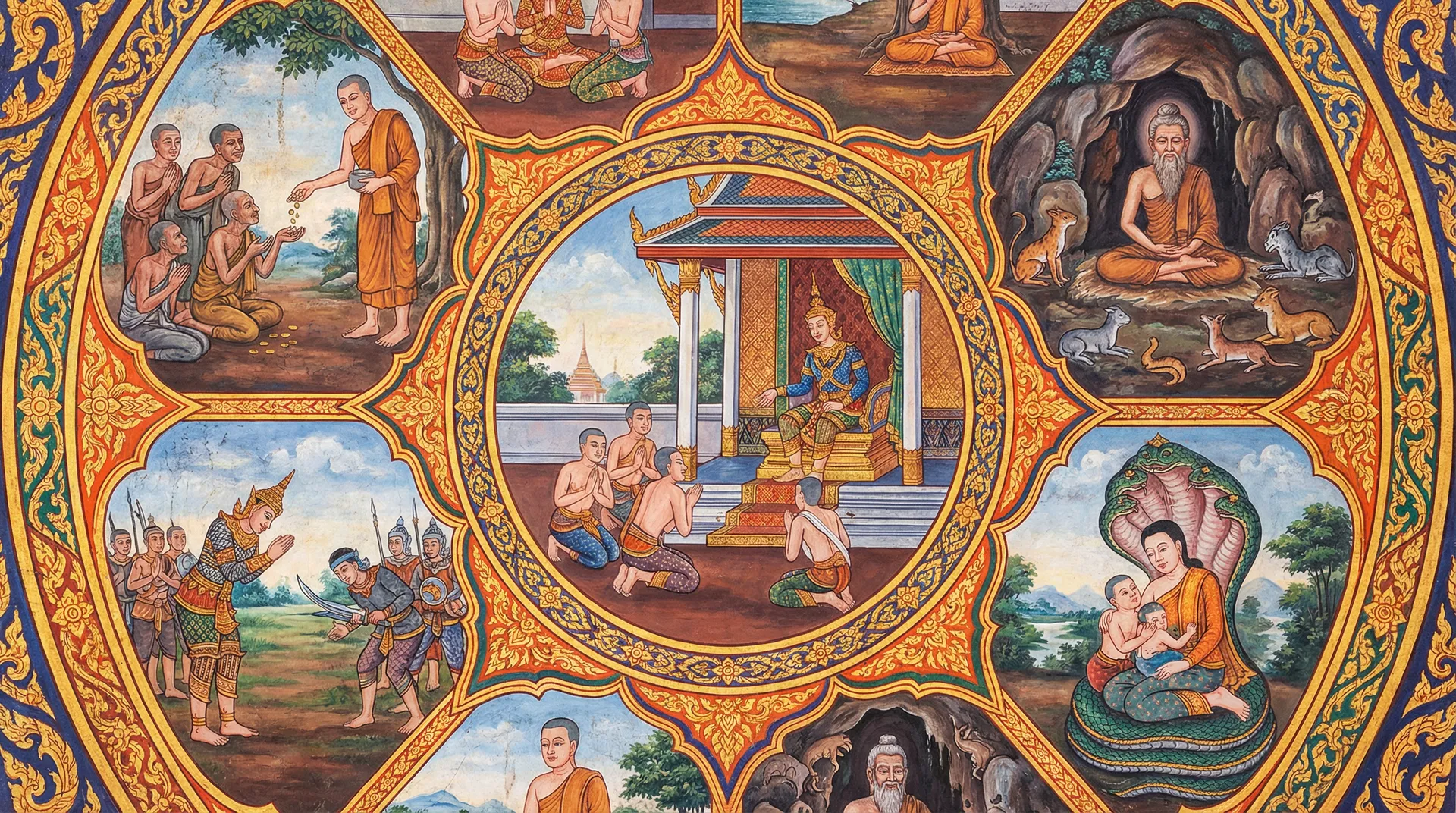
Mulasiri Jataka
Mulasiha Jataka
In the magnificent city of Savatthi, there lived a king named Mulasiha. He was a ruler of great power and immense wealth, but alas, his heart was plagued by suspicion and a deep-seated distrust of others. He lived in a gilded cage of his own making, constantly fearing betrayal and plotting against him.
This pervasive suspicion manifested in peculiar ways. King Mulasiha often spoke in riddles and veiled threats, never truly revealing his intentions. He surrounded himself with courtiers who were as fearful and subservient as they were cunning, each vying for his favor while secretly harboring their own ambitions. His palace, though grand, was a place of constant tension and unspoken anxieties.
One day, a wise and virtuous Bodhisattva was born into the royal family of a neighboring kingdom. From a young age, this prince exhibited a remarkable understanding of human nature and a profound ability to discern truth from falsehood. He possessed an innate sense of justice and a desire to foster harmony and trust wherever he went.
As he grew older, his reputation for wisdom and fairness spread. King Mulasiha, hearing of this prince, became consumed by a new kind of fear – the fear of being outwitted or overshadowed. He saw the prince's virtues not as admirable qualities but as potential threats to his own precarious position.
Driven by his paranoia, King Mulasiha devised a cunning plan to test the prince. He sent an envoy to the prince's kingdom with a series of intricate riddles and seemingly impossible tasks, disguised as gifts of friendship and goodwill. The true intention was to trap the prince, to expose any perceived weakness, and to sow seeds of doubt among his allies.
The prince, however, was no ordinary man. He saw through Mulasiha's deceitful ploy with clarity. Instead of reacting with anger or fear, he met each riddle with a wise and insightful answer, and each impossible task with an ingenious solution. He responded to the veiled threats with unwavering composure and to the supposed gifts with genuine appreciation, turning Mulasiha's own weapons against him.
For instance, when Mulasiha sent a message asking, "What is the strongest of all things?" the prince replied, "The word of a truthful man, for it can move mountains and sway hearts." When asked, "What is the most valuable possession?" he answered, "A clear conscience, for it brings peace even in the midst of turmoil."
King Mulasiha was astonished. His attempts to undermine the prince only served to reveal the prince's extraordinary wisdom and unwavering integrity. The prince's responses were not only accurate but also imbued with a moral compass that reflected his noble character.
The prince, realizing that King Mulasiha's suspicions stemmed from his own inner turmoil and lack of self-worth, decided to address the root of the problem. He sent a humble message back to Mulasiha, not with more riddles or challenges, but with words of understanding and compassion. He acknowledged Mulasiha's fears and gently suggested that true strength and security came not from suspicion and control, but from trust, honesty, and self-acceptance.
He explained that by constantly fearing the worst in others, Mulasiha was only perpetuating his own suffering. He encouraged Mulasiha to cultivate inner peace, to practice generosity, and to seek truth, for these were the foundations of a truly strong and secure reign.
King Mulasiha was deeply moved by the prince's wisdom and his genuine concern. For the first time, he felt a glimmer of hope that his constant suspicion was not an inevitable part of his nature. He began to reflect on his own actions and the emptiness that his paranoia had created.
Though King Mulasiha did not undergo an immediate and complete transformation, the prince's intervention planted a seed of change. The prince's unwavering virtue and his compassionate approach had exposed the futility of suspicion and the power of genuine goodness. The tale of the Mulasiha Jataka became a powerful lesson on the corrosive nature of suspicion and the liberating power of trust, truth, and self-acceptance.
— In-Article Ad —
💡Moral of the Story
Suspicion and paranoia lead to suffering; true strength and security are found in trust, honesty, and self-acceptance.
Perfection: Generosity (Dana)
— Ad Space (728x90) —
More Jataka Tales You May Enjoy
 141Ekanipāta
Mugapakkha Jataka
The Tale of the Mute Prince In the ancient kingdom of Mithila, ruled a just king named Dhanañjaya. H...
💡 True leadership is demonstrated through actions, courage, and compassion, not merely through eloquent speech.
113EkanipātaMahāgovinda Sutta Jātaka
Mahāgovinda Sutta Jātaka In the opulent city of Varanasi, a kingdom blessed with peace and prosperit...
💡 True wisdom lies in maintaining balance and equanimity in the face of both pleasure and adversity. Integrity and unwavering loyalty are the foundations of trust.
1EkanipātaThe Tale of the Great Lotus
The Tale of the Great Lotus In a time long past, when the world was a canvas of verdant forests and...
💡 Impatience is like a fire that burns everything, but wisdom and concentration are the tools that allow us to control situations and achieve goals with stability.
 546Mahānipāta
Mūkapacca Jātaka
The Tale of the Mute Pacce In the ancient city of Mithila, nestled beside the shimmering river Ganda...
💡 True strength lies not in the ability to speak or shout, but in the power of silent compassion and understanding, which can overcome even the most profound despair.
110EkanipātaMora Jataka
The Tale of the King, the Queen, and the Golden Peacock In the prosperous kingdom of Varanasi, nestl...
💡 True beauty lies not in outward appearance but in inner virtues like wisdom, compassion, and kindness. Superficial fascination can blind us to the enduring value of character.
134EkanipātaSattubhatta Jataka
The Tale of the King Who Sought True Happiness In the ancient and prosperous city of Kasi, ruled a k...
💡 True and lasting happiness is an inner state, cultivated through self-understanding, mindfulness, detachment, and compassion, rather than being dependent on external circumstances or possessions.
— Multiplex Ad —